 how-to
How to Find Personal Purpose: A Step-by-Step Guide
Table of Contents
- Step 1: Identify Your Core Values and What Drives You
- Step 2: Reflect on Your Strengths, Obstacles, and Life Trajectory
- Step 3: Explore How Service to Others Shapes Personal Purpose
- Exercises to Find Life Purpose That Actually Move the Needle
- Questions to Ask Yourself to Find Purpose at Every Life Stage
- How to Create a Personal Mission Statement That Sticks
- Signs of Living a Purposeful Life (and What to Do When You're Not)
- How to Find Personal Purpose Through Daily Habits and Legacy
Last Updated: August 2, 2026
Knowing how to find personal purpose is one of the most searched questions in self-development, and for good reason: many people spend years feeling disconnected from their own lives without a clear framework to follow. This guide from Venus Perez breaks down the search for personal purpose into concrete, actionable steps that work whether you're navigating grief, a career crossroads, or simply a nagging sense that something is missing. What most guides get wrong is treating purpose as a destination. It's actually a practice.
According to research published by the American Psychological Association on meaning and well-being, people who report a strong sense of life purpose show measurably higher psychological resilience and life satisfaction across every age group. That's not a soft finding. It has direct implications for how you approach self-discovery, and it means the work you do here has real, lasting impact on your well-being.
Step 1: Identify Your Core Values and What Drives You
Personal purpose is built on a foundation of core values. Without knowing what you genuinely stand for, any purpose statement you write will feel hollow within weeks.
Start by listing the moments in your life when you felt most alive, most proud, or most at peace. Those moments are data points revealing what you actually value rather than what you've been told to value.
A useful exercise: write down ten values from a standard list (honesty, creativity, service, freedom, family, growth, justice, adventure, security, connection). Then cut that list to five, then to three. The discomfort of cutting forces you to confront what genuinely drives you versus what sounds good.
The Difference Between Passion and Purpose
Passion is what excites you. Purpose is what compels you even when it's hard. Many people spend years chasing passion and burning out because passion without purpose has no anchor. Someone might be passionate about writing but find their purpose in giving voice to people who have been silenced. The passion serves the purpose, not the other way around.
Intrinsic motivation is the psychological engine of purpose. When your daily actions align with your core values, you don't need external rewards to keep going.
Step 2: Reflect on Your Strengths, Obstacles, and Life Trajectory
Most people assess their strengths by listing what they're good at professionally. That's too narrow. A genuine strengths assessment includes natural gifts, hard-won skills, and capabilities that emerged specifically because of difficulty.
Think about your life trajectory as a line graph. Where were the peaks? The valleys are especially important. They reveal what you were forced to develop, and forced development often produces the most durable strengths.
Common unrecognized strengths: the ability to hold space for others in pain, the capacity to find humor in darkness, the skill of translating complexity into simple language, and the drive to keep going when others quit.
What Your Hardest Chapters Reveal About Your Calling
The obstacles you've survived are not separate from your purpose. For many people, they are the purpose. A person who navigated addiction and found recovery often becomes the most effective counselor for others in that same struggle. Someone who rebuilt their life after financial collapse understands practical resilience in ways no textbook can teach.
Ask yourself: What did I learn about myself in my hardest season that I could not have learned any other way? The answer frequently points directly toward your calling.
Step 3: Explore How Service to Others Shapes Personal Purpose
Purpose that stays inside your own head is incomplete. Research is consistent: people who orient their sense of meaning around contribution to others report higher levels of fulfillment than those focused primarily on self-actualization.
Service doesn't require a nonprofit job or a missionary trip. It can be as specific as being the person in your neighborhood who checks on elderly residents, or the colleague who mentors new hires, or the parent who models emotional honesty for their children.
Ask yourself three questions: Who do I naturally want to help? What problem do I wish didn't exist in the world? What would I do for someone else even if no one ever knew about it? The overlap in your answers signals your personal legacy and the kind of impact you want to leave behind.
Moving beyond the personal bubble is where purpose becomes a force rather than a feeling.
Exercises to Find Life Purpose That Actually Move the Needle
Exercises to find life purpose fall into two categories: reflective and generative. Reflective exercises look backward at your history. Generative exercises project forward into possibility.
Reflective exercises:
- Write your own eulogy. What do you want people to say about how you lived?
- Create a purpose timeline: mark every experience that shaped your values or worldview.
- Write letters to your past self at ages 10, 20, and 30.
Generative exercises:
- Spend one week saying yes to one thing each day that scares you mildly.
- Volunteer in three different contexts over 30 days. Notice which one pulls at you most.
- Write a "life purpose draft" each Sunday for four weeks. Watch how it evolves.
The Ikigai Framework and the Neurobiological Case for Purpose
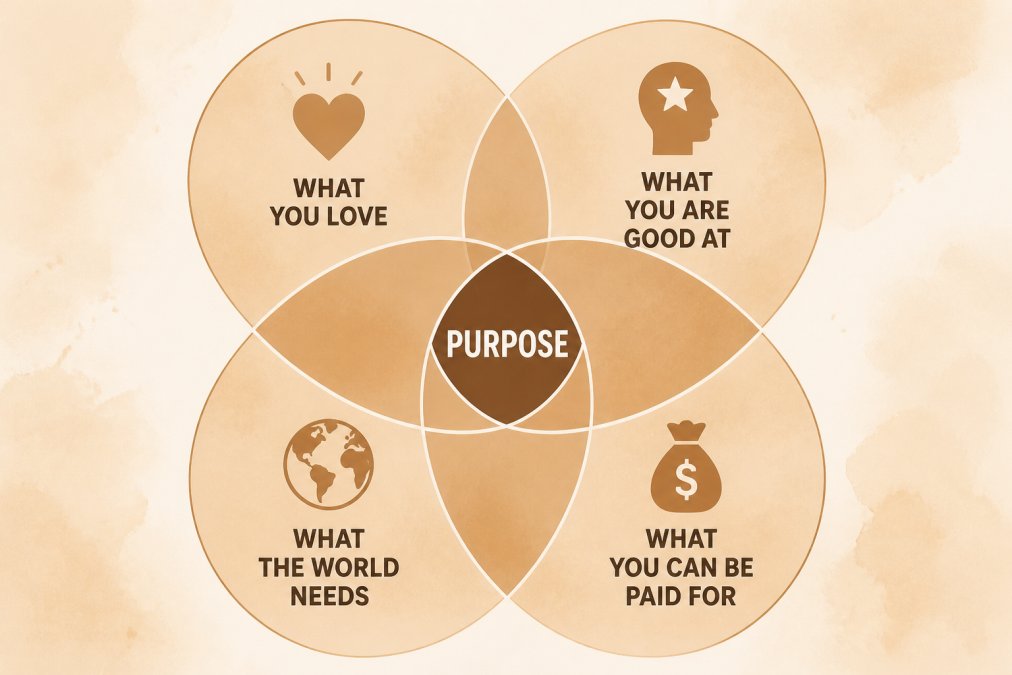
Ikigai is a Japanese concept that translates roughly as "reason for being." It sits at the intersection of four elements: what you love, what you're good at, what the world needs, and what you can be paid for. The framework is useful because it doesn't let you off the hook with any one element alone.
According to neuroscience research on purpose and brain function from the Greater Good Science Center at UC Berkeley, people with a strong sense of life purpose show different patterns of activity in the prefrontal cortex, the region associated with long-term planning and decision-making. Purpose literally changes how your brain operates. It's not just a feeling. It's a functional shift in how you process the world.
Questions to Ask Yourself to Find Purpose at Every Life Stage
Purpose shifts depending on where you are in life. A 22-year-old and a 52-year-old are not searching for the same thing.
| Life Stage | Core Question | Focus Area |
|---|---|---|
| Early adulthood (20s) | What do I want to build? | Exploration and identity |
| Midlife (30s-40s) | What am I actually built for? | Deepening and refinement |
| Transition points (any age) | What needs to change? | Values realignment |
| Later life (50s+) | What do I want to leave behind? | Legacy and contribution |
| Grief or loss (any age) | Who am I without what I've lost? | Reconstruction and meaning |
The Psychological Dark Side of Searching for Purpose
The search for purpose can become its own form of avoidance. Some people spend so long searching for their "true calling" that they never commit to anything long enough to find out whether it matters to them.
Purpose is not found through endless introspection. It's found through action, reflection, and adjustment. You have to try things, fail at some of them, and pay attention to what the failure teaches you. Clarity comes from engagement, not from waiting until you're certain.
The other dark side: people who find a strong sense of purpose sometimes become rigid, using their "mission" to justify ignoring relationships, health, or ethical limits. Purpose without humility is dangerous.
How to Create a Personal Mission Statement That Sticks
A personal mission statement is a single sentence that describes who you serve, what you do for them, and why it matters. Use this structure: "I [action verb] [who you serve] so that [the outcome or transformation you create]."
Examples:
- "I help people navigating grief find language for what they're feeling so they don't have to face it alone."
- "I build systems that give small business owners back their time so they can focus on the work they actually started their business to do."
- "I create environments where children feel safe enough to ask questions that matter."
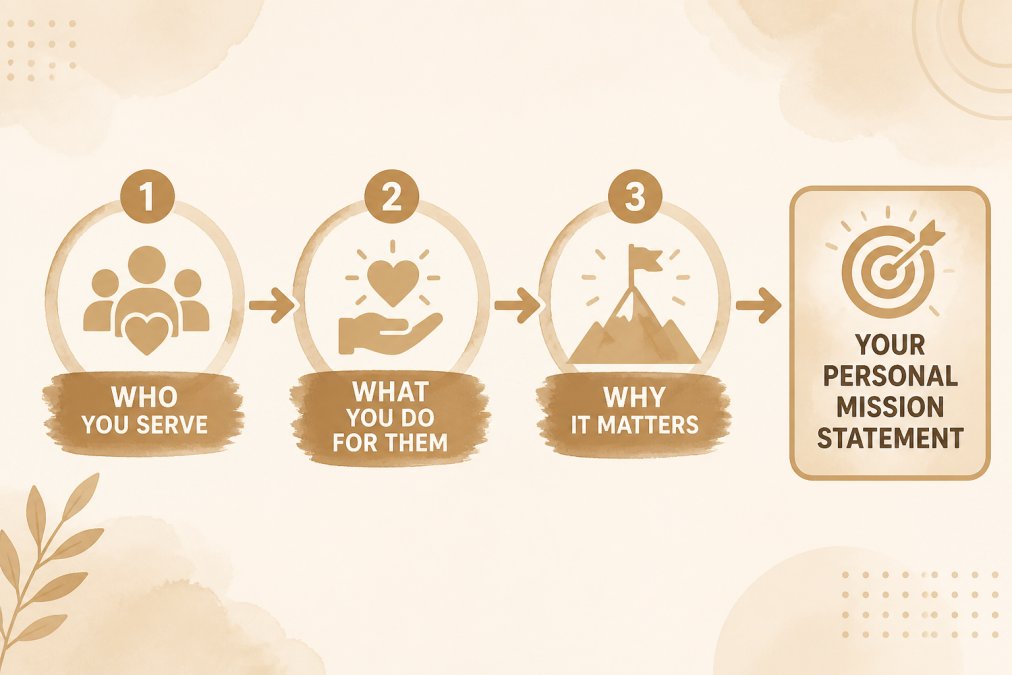
The most common mistake is writing a mission statement that sounds inspiring but could apply to anyone. "I help people live better lives" is not a mission statement. It's a slogan. The more specific and personal your statement, the more it will actually guide your decisions.
Revisit your mission statement every six months. It should evolve as you do.
Signs of Living a Purposeful Life (and What to Do When You're Not)
Signs of living a purposeful life include a felt sense of direction even on difficult days, the ability to tolerate discomfort because you understand why it's worth it, and a quality of presence in your relationships that comes from knowing what actually matters to you.
More specific markers: you make decisions more easily because you have a values filter, you feel genuine satisfaction in your work, you're drawn toward growth rather than comfort, you think about contribution as naturally as personal gain, and your daily habits reflect what you say you care about.
When you're not living purposefully, the signs are equally clear: chronic restlessness, a sense that you're performing your life rather than living it, difficulty making decisions, and a tendency to numb rather than feel.
What to do when you're not: go back to your values list. Check whether your current daily habits are aligned with those values. Misalignment between stated values and actual behavior is almost always the source of disconnection. The fix is not a new purpose. It's closing the gap between what you say matters and how you spend Tuesday.
According to research on values-behavior alignment and well-being from Harvard Health Publishing, people who act in ways consistent with their stated values report significantly higher life satisfaction, even when their external circumstances are difficult.
How to Find Personal Purpose Through Daily Habits and Legacy
Purpose lives in the small, repeated actions of daily life, not in a single moment of revelation. Purpose-driven people don't wake up every morning with clarity and certainty. They wake up with practices that keep them oriented.
Those practices look like this:
- A morning reflection of two to three minutes asking: what matters most today?
- A weekly review asking: did my actions this week reflect my values?
- A quarterly check-in with your personal mission statement.
- Regular service to others, even in small ways.
- Honest conversations with people who know you well enough to tell you the truth.
Legacy is the long-term expression of those daily habits. Most people who leave meaningful legacies didn't plan a legacy. They lived their values consistently and the legacy emerged naturally.
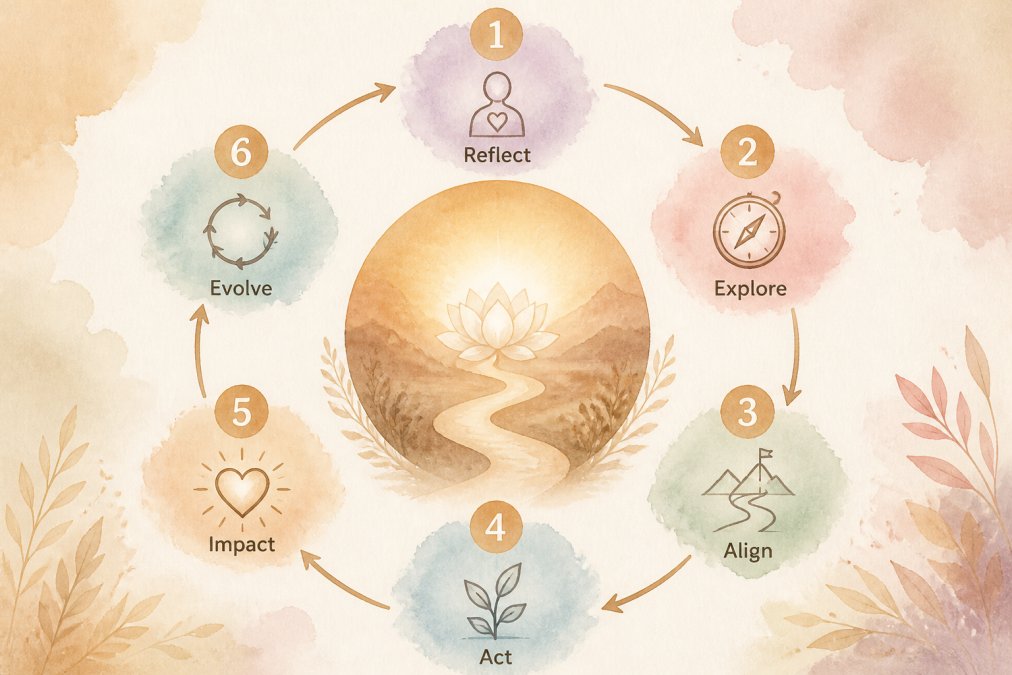
The work of self-discovery is never fully finished. That's not a problem. It's the design. A purpose that never evolves is a purpose you've outgrown. The goal is not to arrive. The goal is to keep asking better questions and acting on the answers with more courage than the last time.
Venus Perez's approach to this work, rooted in practical guidance on gratitude, mindfulness, and manifestation, is built on exactly this understanding: that transformation happens through consistent, values-aligned action, not through a single breakthrough moment. If you're ready to go deeper, Motivate to Manifest offers a structured path for aligning your thoughts, emotions, and daily habits with the life you actually want to build.
Frequently Asked Questions
What causes a lack of purpose in life?
A lack of personal purpose often stems from living according to other people's expectations rather than your own core values. Major life transitions, grief, burnout, or years of negative thought patterns can sever your connection to what genuinely matters to you. The absence of self-reflection, meaningful work, or contribution to something beyond yourself also deepens that emptiness. Reconnecting with purpose usually starts with small, honest questions about what brings you real satisfaction, not just temporary comfort.
Can your life purpose change over time?
Yes, and that is completely normal. Personal purpose is not a fixed destination. At different life stages, your values, strengths, and circumstances shift. A purpose that fit your twenties may feel hollow in your forties. Grief, career changes, parenthood, or recovery from a major setback frequently reorient what feels meaningful. Treat purpose as something you refine over time rather than something you find once and keep forever. Regular self-reflection helps you stay aligned as you grow.
What are the signs you have found your purpose?
Signs of living a purposeful life include a consistent sense of direction even during difficult periods, intrinsic motivation that does not depend on external rewards, and a feeling that your daily habits connect to something larger than yourself. You tend to lose track of time doing work that aligns with your values, feel genuine satisfaction from contributing to others, and experience psychological resilience when obstacles arise. Life satisfaction generally rises, and existential questions feel less threatening because you have a clear personal framework.
How do I start living with more intention when I feel completely stuck?
Start smaller than you think necessary. Pick one question to ask yourself daily, such as 'What did I do today that felt genuinely meaningful?' Write the answer down. Over two to four weeks, patterns emerge that point toward your values and strengths. From there, draft a rough personal mission statement using the simple formula: who you help, how you help them, and why it matters. Intentional living builds through consistent small actions, not a single dramatic decision. A structured self-help resource can also give you a repeatable framework to follow.
What exercises to find life purpose work best for beginners?
Three exercises consistently produce clarity for people starting out. First, the Eulogy Exercise: write what you want people to say about your life and work backward from there. Second, the Peak Moments Audit: list ten times you felt fully alive and identify what they had in common. Third, the Ikigai map: draw four overlapping circles covering what you love, what you are good at, what the world needs, and what sustains you financially. Where all four overlap is a strong signal toward your personal purpose.
Finding personal purpose is genuinely difficult work, and most people need more than good intentions to make it stick. Venus Perez's collection of self-help titles, including Motivate to Manifest, combines spiritual principles with practical daily applications to help you move from searching to living with intention. Get the book and start building a life that reflects what actually matters to you.
This article was written using GrandRanker